Call Us At +91 9811618476

Designated Smoking Zones
Designated Smoking Zones
When Did Smoking Stop in Restaurants? A Brief History
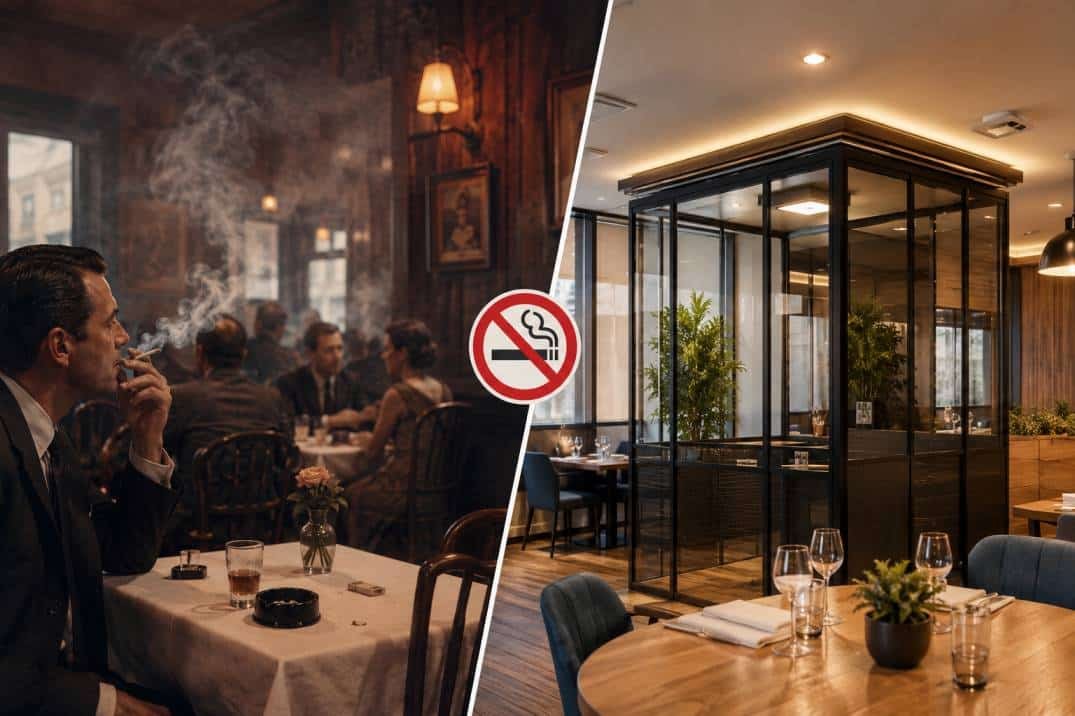
For anyone who dined out regularly before the mid-2000s, ashtrays on restaurant tables and a haze of cigarette smoke in the air were simply part of the experience. Today, smoking indoors at a restaurant is almost unthinkable in most parts of the world — a shift that happened faster and more decisively than many people realise. Understanding how and when this change happened offers useful context for why designated smoking areas exist today, and why they look the way they do.
At SmokinMe, we build the designated smoking solutions that emerged directly from this regulatory shift — purpose-built spaces that let hospitality venues accommodate smokers without smoke spreading into dining areas. This guide traces how restaurant smoking bans developed globally and in India specifically, and what that history means for how businesses approach smoking accommodation today.
The Era Before Restaurant Smoking Bans
For most of the twentieth century, smoking indoors — including in restaurants, bars, offices, and airplanes — was simply normal. Ashtrays were standard table furniture, smoking and non-smoking sections (when they existed at all) typically shared the same air space with no meaningful physical separation, and the idea of a completely smoke-free restaurant would have seemed unusual rather than expected.
This began to shift as public health research increasingly documented the health risks of secondhand smoke exposure, not just active smoking. As this evidence accumulated through the latter half of the twentieth century, public opinion and regulatory attitudes gradually moved toward treating secondhand smoke as a genuine public health issue requiring policy response, rather than purely a matter of individual choice affecting only the smoker.
The Global Shift: How Restaurant Smoking Bans Spread
Restaurant and indoor public smoking bans didn’t happen all at once globally — they spread progressively, market by market, over roughly two decades, generally following a similar pattern: cities and states leading with initial restrictions, followed by broader national legislation.
Early movers in the 1990s. Some U.S. cities and a handful of other jurisdictions began implementing local restaurant and workplace smoking restrictions in the early-to-mid 1990s, often facing significant pushback from the hospitality industry at the time, which frequently argued such bans would hurt business.
Momentum builds in the early 2000s. By the early 2000s, a growing number of U.S. states, along with several other countries, had implemented comprehensive indoor smoking bans covering restaurants and bars. Ireland’s 2004 workplace smoking ban, which included pubs and restaurants, was a particularly notable and influential example, given the strong association between pub culture and smoking in Irish society at the time.
Broader international adoption through the mid-to-late 2000s. Throughout this period, many countries progressively implemented similar restrictions, often citing both public health evidence and the practical experience of jurisdictions that had already implemented bans without the economic harm the hospitality industry had predicted.
India’s framework takes shape. India’s Cigarette and Other Tobacco Products Act (COTPA) was enacted in 2003, establishing the foundational legal framework prohibiting smoking in public places, including restaurants, with designated smoking area provisions built into the law from the outset rather than an outright, unconditional ban.
Why the Predicted Business Harm Largely Didn’t Materialise
A common argument against restaurant and bar smoking bans, especially in the years before they were widely implemented, was that they would significantly hurt business — driving away smoking customers and reducing overall revenue. In practice, this argument was largely not borne out by subsequent economic research across the many jurisdictions that implemented bans. Multiple studies conducted after bans took effect in various markets generally found neutral or even positive effects on restaurant and bar revenue, once bans had been in place long enough for any initial adjustment period to pass.
Several factors likely contributed to this outcome: non-smokers, who represented the majority of the population in most markets, were more likely to dine out once smoke-free environments became standard; and smokers themselves often adapted their behaviour — stepping outside briefly to smoke — rather than avoiding restaurants and bars altogether.
Why Full Bans Gave Way to Designated Smoking Areas
While the trajectory in many markets moved toward comprehensive indoor smoking bans, most regulatory frameworks — including India’s COTPA — didn’t eliminate accommodation for smokers entirely. Instead, the more common and lasting approach has been prohibiting smoking in general enclosed public spaces while explicitly permitting it within properly designated, separated smoking areas that meet specific ventilation and containment requirements.
This reflects a practical balance: protecting non-smokers from secondhand smoke exposure, which was the central public health rationale for bans in the first place, while still providing smokers a legitimate, contained space rather than pushing smoking into unmanaged, informal locations that would achieve neither goal well.
This is precisely the regulatory environment that created ongoing demand for properly designed smoking solutions — cabins, rooms, and lounges — rather than eliminating that need altogether once bans took effect.
India’s Regulatory Framework in Detail
Under COTPA, 2003, Section 4 prohibits smoking in public places, including restaurants, while explicitly allowing for designated smoking areas that meet specific requirements around ventilation, signage, and physical separation from non-smoking spaces. This means Indian restaurants have never faced a total smoking ban in the way some might assume — accommodation for smoking has been part of the legal framework since its inception, provided it takes the form of a properly compliant designated area.
For restaurant owners in India today, this history matters practically: the regulatory expectation isn’t “no smoking anywhere,” but rather “smoking only within a genuinely compliant designated space.” Understanding this distinction helps restaurant operators approach smoking accommodation correctly, rather than either ignoring the requirement entirely or over-restricting beyond what the law actually requires.
How Restaurant Smoking Accommodation Has Evolved Since the Bans
In the years since comprehensive indoor smoking restrictions took hold, the approach to accommodating smokers in hospitality settings has evolved considerably:
From informal outdoor smoking to purpose-built solutions. In the early years following bans, many venues simply pointed smokers toward an outdoor doorway or alley, with minimal planning around comfort, weather protection, or containment. Over time, this has increasingly given way to purpose-built designated smoking cabins and outdoor shelters, designed specifically for the purpose rather than improvised.
Filtration technology has advanced significantly. Early designated smoking rooms often relied on basic exhaust ventilation, which frequently underperformed at actually containing smoke and odour. Modern multi-stage filtration — combining HEPA-grade particle capture with activated carbon odour control — represents a substantial improvement in genuinely solving the containment problem that early solutions often only partially addressed.
Regulatory expectations have become more specific. As designated smoking area requirements have matured across jurisdictions, expectations around ventilation standards, signage, and physical separation have generally become more detailed and specific than the earlier, more general requirements first implemented alongside initial bans. Explore all products of SmokinMe.
What This History Means for Restaurant Owners Today
Understanding this trajectory helps frame smoking accommodation correctly for restaurant and hospitality operators: this isn’t a temporary regulatory phase that might reverse, nor is it an unreasonable imposition without practical accommodation. It’s a stable, mature regulatory framework that explicitly anticipates and permits designated smoking spaces, provided they’re properly designed and compliant.
For restaurants specifically, this means the practical question isn’t whether to accommodate smoking at all, but how to do so in a way that genuinely satisfies both compliance requirements and the comfort of both smoking and non-smoking patrons. A well-designed designated smoking area — whether a compact indoor cabin or a properly weather-protected outdoor space — achieves this far more effectively than either an informal, unplanned outdoor spot or ignoring the requirement altogether.
From Historical Context to Practical Solutions
This history underscores why purpose-built smoking cabins exist as a distinct product category today, rather than restaurants simply designating an existing room or doorway as a smoking area. The decades-long evolution from unrestricted indoor smoking, through comprehensive bans, to mature designated-area frameworks has consistently pushed toward more genuinely effective containment solutions — which is exactly the gap modern smoking cabin technology fills.
Why SmokinMe for Restaurant and Hospitality Smoking Solutions
We design smoking cabins specifically suited to restaurant and hospitality environments, where guest experience matters alongside compliance — combining genuine multi-stage HEPA-14 and activated carbon filtration with a design aesthetic that integrates into modern dining and hospitality spaces rather than standing out as an industrial afterthought.
Contact SmokinMe today to discuss a compliant, well-designed smoking solution for your restaurant or hospitality property.
Also Read:- Outdoor Smoking Shelters: Weather-Protected Solutions for Businesses
Frequently Asked Questions
When did restaurants stop allowing smoking?
Restaurant smoking bans spread progressively rather than happening all at once, with early city and state-level restrictions in the U.S. beginning in the early-to-mid 1990s, followed by broader adoption through the early-to-late 2000s across many countries, including Ireland’s notable 2004 workplace smoking ban covering pubs and restaurants.
When did India ban smoking in restaurants?
India’s Cigarette and Other Tobacco Products Act (COTPA) was enacted in 2003, prohibiting smoking in public places, including restaurants, while explicitly permitting designated smoking areas that meet specific requirements — rather than an outright, unconditional ban.
Why did restaurants stop allowing smoking indoors?
Restaurant smoking bans developed primarily in response to accumulating public health evidence about the risks of secondhand smoke exposure to non-smokers, not just active smokers, shifting regulatory and public attitudes toward treating it as a genuine public health issue requiring policy response.
Did restaurant smoking bans hurt restaurant business?
Despite common predictions that bans would significantly harm revenue, economic research conducted after bans took effect in various markets generally found neutral or even positive effects on restaurant and bar revenue once initial adjustment periods had passed, likely due to increased patronage from the non-smoking majority.
Are restaurants allowed to have designated smoking areas today?
Yes — in most regulatory frameworks, including India’s COTPA, comprehensive smoking bans didn’t eliminate all accommodation for smokers. Restaurants can operate designated smoking areas that meet specific ventilation, signage, and separation requirements, alongside a smoke-free general dining area.
What was Ireland’s role in the history of restaurant smoking bans?
Ireland’s 2004 workplace smoking ban, which included pubs and restaurants, was a particularly influential example internationally, given the strong cultural association between pub culture and smoking in Ireland at the time, and it helped demonstrate that comprehensive bans could be implemented without the economic harm often predicted.
How has smoking accommodation in restaurants changed since the bans?
Early accommodation often involved informal outdoor smoking spots with minimal planning, which has increasingly given way to purpose-built designated smoking cabins and outdoor shelters using advanced multi-stage filtration technology, representing a significant improvement over early basic exhaust ventilation approaches.
What does COTPA require for restaurant smoking areas in India?
Under COTPA, Section 4 prohibits smoking in public places, including restaurants, while allowing designated smoking areas that meet specific requirements around ventilation, signage, and physical separation from non-smoking spaces. Confirm current specific requirements with your compliance team given potential state and local variations.
Why do restaurants use smoking cabins instead of just designating a room?
A properly engineered smoking cabin, with genuine multi-stage filtration, contains smoke and odour far more effectively than simply designating an existing room without dedicated filtration infrastructure — meeting both the practical need for genuine containment and evolving regulatory expectations around ventilation standards.
How can restaurants ensure their designated smoking area is genuinely compliant?
Confirm current requirements with your local compliance authority, and choose a smoking solution with genuine multi-stage filtration — combining HEPA-grade particle capture with activated carbon odour control — rather than basic ventilation alone. Contact SmokinMe to discuss a compliant smoking cabin designed for restaurant and hospitality use.