Call Us At +91 9811618476

Designated Smoking Zones
Designated Smoking Zones
Smoking Zones for Malls and Public Spaces
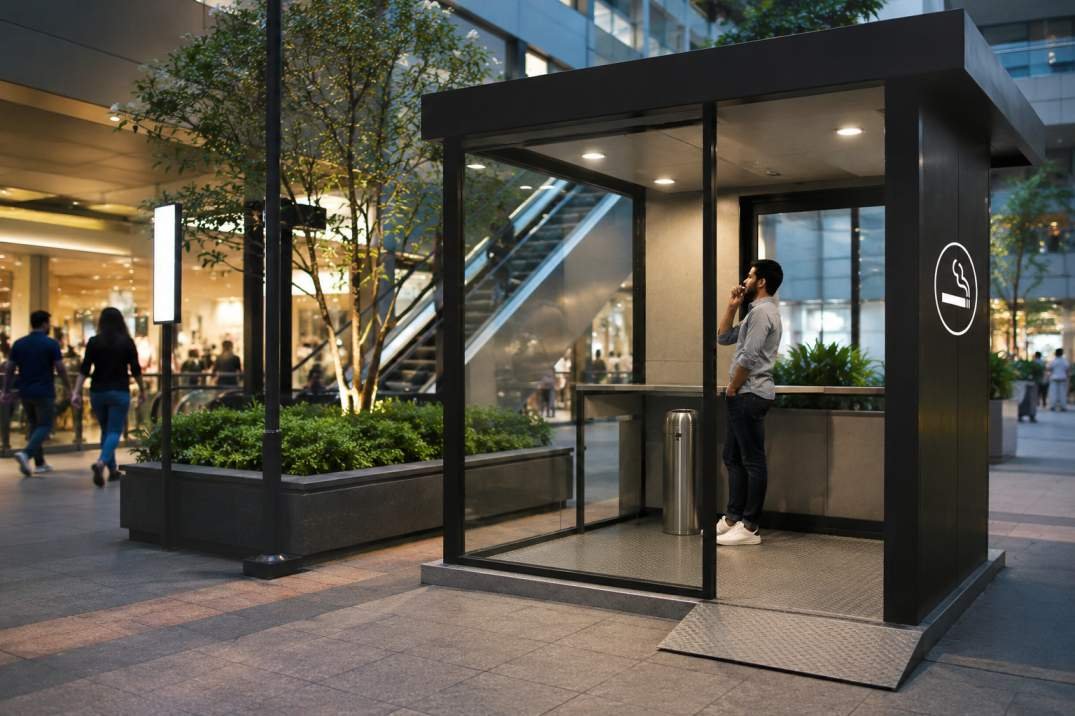
A public smoking zone is a defined, contained area outside a building where people can smoke away from entrances, walkways and crowds. SmokinMe designs outdoor smoking zones for malls, transit hubs, campuses and other high-footfall spaces. Our enclosed outdoor cabins filter smoke inside the unit, protect users from rain and heat, and keep the surrounding area cleaner.
The cluster at the mall entrance
Saturday evening at a large mall in Noida. The main entrance is the busiest spot on the property. It’s also where everyone smokes: families walking in, children in prams, shoppers carrying food from the court upstairs, all passing through the same haze. Security moves people along. Ten minutes later a new group forms at the next door. Butts pile up in the planters, the drains and the parking ramp. Housekeeping clears them every morning and they’re back by lunch. The same picture plays out at bus terminals, railway forecourts, metro exits and office plazas. Smoking inside is already banned. The trouble is that “outside” has no shape, so it ends up being the doorway.Is smoking in public places allowed in India?
No. Section 4 of COTPA prohibits smoking in public places, which covers malls, cinemas, offices, transport and other places the public can access. The exceptions for designated smoking areas apply only to airports, hotels with 30 or more rooms and restaurants with 30 or more seats.What is the fine for smoking in public places in India?
Smoking in a public place under COTPA can be fined up to ₹200. Owners and managers of public places also have duties, including displaying the prescribed “No Smoking” signage and not allowing smoking on the premises.Can malls in India have a smoking zone?
Indoors, no. Malls are public places, and indoor smoking areas are not among the permitted exceptions. Many malls instead manage smoking on the outdoor edges of their property, at a defined location away from entrances, rather than leaving it to every doorway. Whether and where that is acceptable depends on how your premises are classified and on local rules, so it should be confirmed with your compliance team before planning.Why “contained and away” beats “indoors and filtered”
You’ll find advice online, and from some suppliers, suggesting an indoor smoking room with filtration solves the problem inside a mall. We don’t recommend it. Public health bodies point out that ventilation and separate rooms don’t fully eliminate exposure to secondhand smoke. In a crowded indoor space full of families and food outlets, that risk isn’t worth taking, and it also runs against the law for most public places. What works better is a contained outdoor zone:- Away from the entrances, so nobody walks through smoke to get in.
- Enclosed and filtered, so smoke doesn’t drift across walkways, seating or parking.
- Visible and signposted, so security can direct people somewhere specific instead of just moving them on.
- Comfortable enough to use, with shelter from monsoon rain and summer heat.
Where should a public smoking area be placed?
Location decides whether a zone works. These are the questions we ask on site.Is it clear of entrances, exits and air intakes?
Keep the zone well away from doors, windows and fresh-air intakes. Smoke drawn into a mall’s air handling ends up in the food court.Is it on a natural path?
Smokers will use a zone that’s on the way to the parking, taxi stand or bus bay. A zone hidden at the back of the service yard won’t get used.Can security point to it?
Staff need a simple instruction: “The smoking zone is by the parking exit.” Without a specific place to send people, enforcement turns into arguments.What happens to the butts?
A contained zone with proper receptacles keeps litter in one place. That alone cuts daily cleaning across the rest of the forecourt.Is the ground ready?
Level, drained ground matters during the monsoon. Rooftop or podium locations need a structural check.Spaces we design for
| Space | Typical problem | What usually works |
|---|---|---|
| Shopping malls | Smoking at every entrance | One or two outdoor zones by parking exits |
| Bus terminals and railway forecourts | Smoking on platforms and in waiting areas | Outdoor cabins at the edge of the forecourt |
| Metro and transit exits | Clusters at station steps | Zones set back from the exit flow |
| Office plazas and IT parks | Smoking by lobby doors | Zones near parking or food courts, away from lobbies |
| Universities and campuses | Hidden spots behind buildings | Defined zones or a campus-wide smoke-free policy |
Peak days, events and festivals
A zone that copes on a Tuesday can be overwhelmed on Diwali weekend, during an end-of-season sale, or after a concert at the mall’s event space. Footfall at a large mall can multiply several times on peak days, and smokers scale with it. Plan for those days, not the average:- Size for weekend evenings. That’s when queues form and people drift back to the doors.
- Consider a second zone on the far side of the property, so one exit doesn’t carry all the load.
- Brief security before big events. A one-line instruction on where to direct smokers saves a lot of arguments at the door.
- Increase emptying and cleaning on peak days. An overflowing zone pushes people away.
Signage that people actually follow
Signs work best when they answer the question a smoker is asking at that moment: “Where can I go?” A “No Smoking” board at the door tells people what not to do. A directional sign pointing to the smoking zone tells them what to do instead, and that’s the one that changes behaviour. Place directional signs at entrances, exits to parking and taxi stands, and along the route to the zone. Keep the mandatory “No Smoking” signage at every public entry as the law requires. Contact Us!What a SmokinMe outdoor zone includes
Enclosed filtered cabin. Smoke is captured and filtered inside the unit, so the area around it stays cleaner. Weather protection. Users stay out of the rain and the dust, which is the main reason they’ll use the zone instead of a doorway. Fire-safe construction and managed ash disposal. Lit material stays in one place. No ducting or civil work. Units need a level base and power. Optional vending. A vending kiosk nearby with water and snacks keeps people from wandering. For the full range, see our products page.How a public-space project works
- Site walk. We map where people currently smoke and how people move through the site.
- Compliance check. We work with your compliance team on how the rules apply to your premises.
- Proposal. Zone locations, unit types and signage plan.
- Quote. A written specification and price.
- Installation and maintenance. Typically a day per unit, then scheduled servicing.