Call Us At +91 9811618476

Designated Smoking Zones
Designated Smoking Zones
Smoking Shelters for Factories and Industrial Sites
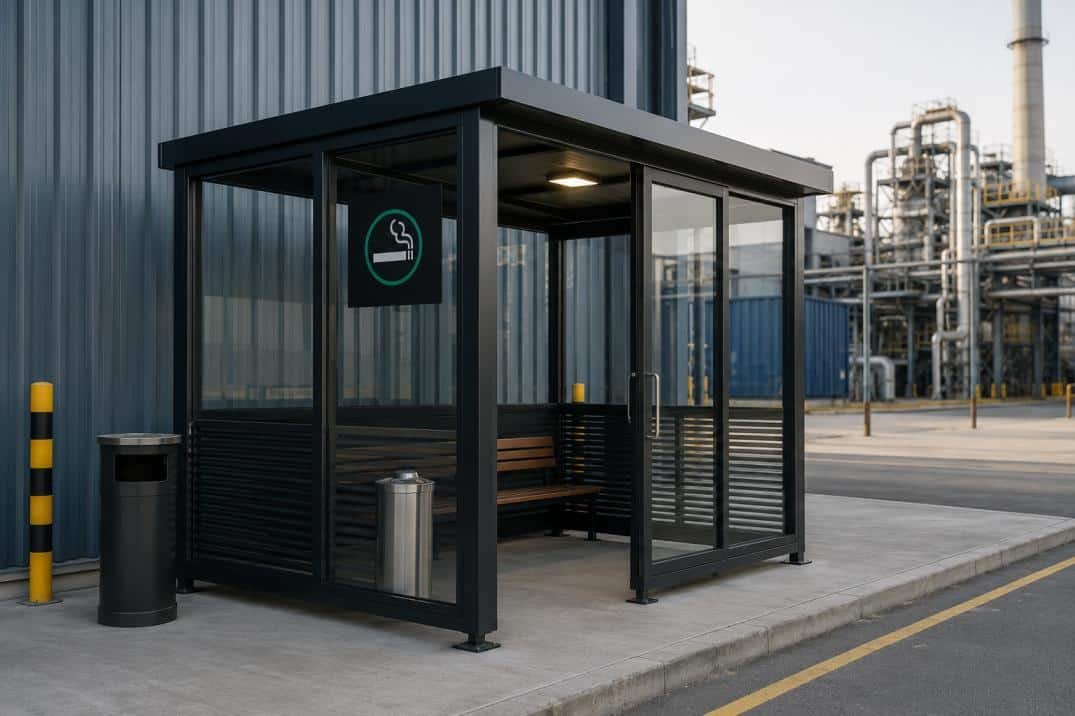
A factory smoking shelter is an enclosed, weatherproof structure that gives workers one controlled place to smoke, well away from fuel, flammable stock, loading bays and production lines. SmokinMe supplies enclosed outdoor smoking cabins for factories, warehouses and industrial plants. They contain lit material and filter smoke inside the unit, through Indian heat, dust and monsoon.
On an industrial site, this is a fire-safety decision first and a comfort decision second.
For sites with flammable materials, the enclosed option is the safer one.
Where your workers smoke right now
Ask your safety officer where people smoke on site. Then walk round and check. At a typical plant in Manesar, Pune or Sriperumbudur, the official answer is “outside the gate.” The real answers are different. Behind the scrap shed, because it’s shady. In the lee of the diesel store, because it’s out of the wind. On the loading dock between trucks. In the corner of the warehouse where the CCTV doesn’t reach. None of those places were chosen for safety. They were chosen because they were comfortable and out of sight. Short shift breaks make it worse. A 10-minute break doesn’t leave time to walk to the main gate, smoke and come back. So workers don’t. They find somewhere closer.How do I reduce fire risk from smoking at a factory?
Give smoking one fixed, enclosed location away from every hazard, make it closer and more comfortable than the hidden spots, and enforce the rule everywhere else. A ban with no alternative pushes smoking into exactly the places you can’t see. In practice, that means four things:- One designated place (or one per zone on a large site), clearly marked.
- Away from hazards: fuel, gas cylinders, solvents, flammable stock, dust-producing processes, loading bays and vehicle routes.
- Close enough to use within a shift break, so workers don’t improvise.
- Contained ash and butt disposal, so nothing lit leaves the shelter.
Where should a smoking area be located on an industrial site?
These are the checks we run on every industrial site visit.Distance from fire hazards
The first constraint. Map fuel storage, gas banks, chemical stores, paint shops, dust-generating processes and flammable stock, then keep the shelter well clear of all of them and of the routes between them.Distance from vehicles
Forklifts, trucks and reversing vehicles don’t mix with groups of people standing around. Keep the shelter off vehicle routes and away from loading bays.Walking time from the shop floor
Measure it. If the walk takes up half the break, the shelter won’t be used. Large sites often need two or three smaller shelters instead of one central one.Wind and air intakes
Keep the shelter downwind of buildings where possible and away from air intakes and open doors to production areas, especially in food, pharma and clean manufacturing.Ground and drainage
Industrial yards flood in the monsoon. A level, drained base keeps the entrance usable all year.Why an enclosed cabin beats an open shelter on industrial sites
An open shelter with a roof and two sides keeps rain off. It doesn’t stop sparks, embers or blown ash, and it doesn’t stop smoke drifting across the yard.| Factor | Open smoking shelter | Enclosed SmokinMe cabin |
|---|---|---|
| Embers and ash | Can blow out on the wind | Contained inside the unit |
| Smoke drift | Spreads across the yard | Filtered inside the unit |
| Weather | Partial protection | Full rain, wind and dust protection |
| Comfort in summer | Shade only | Conditioned air inside |
| Fire-safe construction | Varies | Fire-safe materials |
Industries we work with
Automotive and engineering plants. Large sites, multiple shifts, oil and fuel on site. Usually two or more shelters near shop exits. Warehouses and logistics hubs. Constant vehicle movement and stacked stock. Shelters well away from docks and racking. Pharma and food manufacturing. Strict hygiene zones and air-intake concerns. Shelters placed away from clean areas and intakes. Chemical and process plants. The strictest hazard mapping. Shelters only in locations approved under the site’s safety plan. Textile and garment units. Lint and fabric dust are highly flammable. Smoking well clear of production and storage.What about smoking inside the factory?
Indoor smoking in workplaces is restricted under Indian law, and on industrial sites it’s also a fire risk. We recommend a contained outdoor shelter, not an indoor smoking room, for factories and warehouses.What a SmokinMe industrial shelter includes
- Enclosed construction with a door, so embers and ash stay inside.
- Built-in filtration, capturing smoke at the source.
- Fire-safe materials throughout.
- Weather and dust protection for year-round use.
- No ducting or civil work: a level base and a power point.
- Optional vending: a vending kiosk next to the shelter for water and snacks keeps workers on site during breaks.
Sizing for shift patterns
Factories don’t have one rush hour; they have several, tied to shift breaks. On a three-shift plant, the shelter may see a burst of users at each tea break and meal break, plus a spike at shift change when two shifts overlap. Size for the largest of those bursts, not the daily total. A simple way to estimate it:- Count smokers per shift (HR records or a quick anonymous survey).
- Note which breaks are shared across lines and which are staggered.
- Assume a large share of a line’s smokers use the shelter during its break.
- Allow five to seven minutes per visit.
Contractors, drivers and visitors
Your own workforce isn’t the only group on site. Truck drivers waiting at the dock, contractors on a maintenance shutdown and visiting vendors often cause the most trouble, because nobody briefed them.- Truck drivers: a shelter near the driver waiting area, away from the dock itself, stops smoking between vehicles.
- Contractors: add the smoking rule to contractor induction and permit-to-work paperwork.
- Visitors: a line in the security gate briefing and a sign at reception.
Making the policy stick
A shelter on its own doesn’t change behaviour. The sites that see results pair it with:- A clear written rule: smoking only in the shelter, nowhere else on site.
- Briefings in the workers’ languages, at induction and toolbox talks.
- Consistent enforcement across shifts, including supervisors and contractors.
- Removal of the old spots: clear the improvised ashtrays from behind the scrap shed.
- Cessation support for workers who want to quit.
How an industrial project works
- Site safety walk with your EHS team, mapping hazards and current smoking spots.
- Location proposal checked against your fire safety plan.
- Quote with a written specification.
- Installation, typically a day per unit, scheduled around production.
- Maintenance, with filter changes adjusted for dusty conditions.