Call Us At +91 9811618476

Designated Smoking Zones
Designated Smoking Zones
Smoke Filtration Systems Explained: HEPA, Activated Carbon & What India's Offices Actually Need
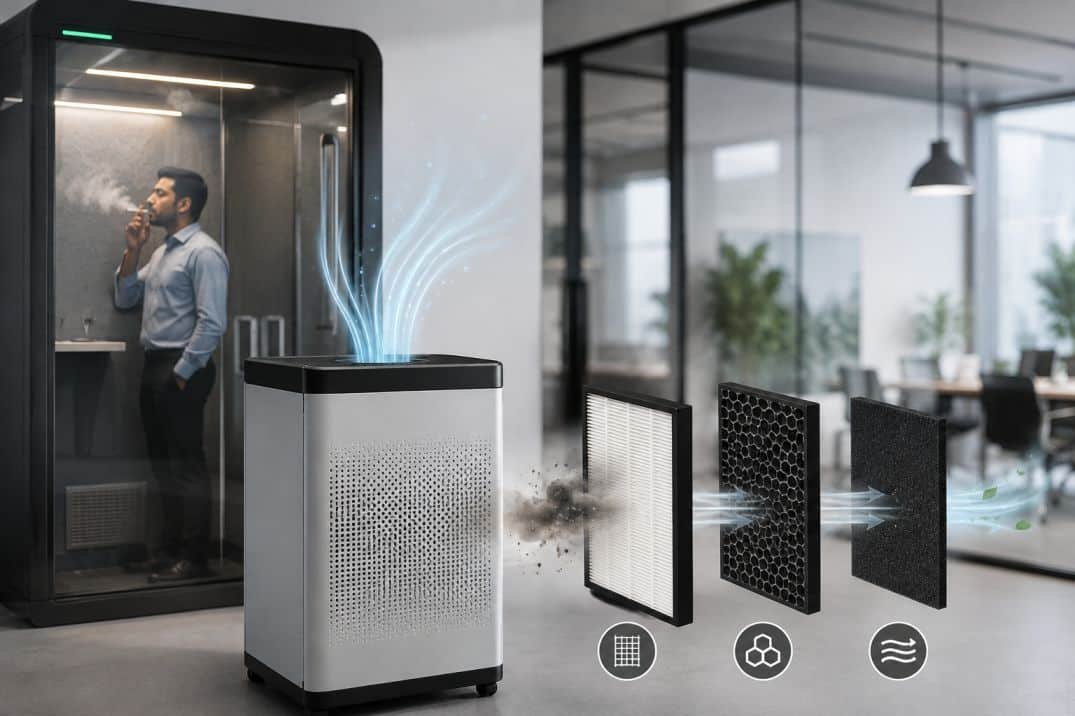
Every office considering a smoking cabin or smoking room eventually runs into the same question: what filtration system actually removes smoke, and how do you tell a genuine, effective system from a marketing claim? “Air purification” and “advanced filtration” appear on nearly every product page in this category, but very few explain what’s actually happening inside the unit.
This gap matters more than it might seem. A facilities manager evaluating vendors, an HR team responding to employee complaints about smoke odour, or a compliance officer trying to satisfy workplace safety requirements all need to understand the actual mechanics of smoke filtration — not just trust a supplier’s claims at face value. Without that understanding, it’s nearly impossible to tell whether a proposed solution will genuinely solve the problem or simply move it somewhere less visible.
At SmokinMe, we build every smoking solution around a specific, measurable filtration standard — not a vague promise. In this guide, we break down exactly how HEPA and activated carbon filtration work, why you need both rather than either alone, and what Indian offices should actually look for when evaluating a smoke filtration system.
Why Smoke Filtration Is Harder Than It Sounds
Tobacco smoke isn’t a single substance you can filter out with one technology. It’s a mix of solid particles (ash, tar, particulate matter) and gaseous compounds (odour, volatile organic compounds, carbon monoxide). A filtration system that only handles one of these leaves the other completely untouched — which is exactly why so many “smoke-free” smoking rooms still smell like smoke within a few metres of the door.
Effective smoke filtration requires two distinct technologies working together: HEPA filtration for particles, and activated carbon filtration for odour and gases. Understanding what each one actually does is the first step to evaluating any smoke filtration system properly — and it’s the difference between asking a vendor “does this remove smoke?” and asking the much more precise question, “does this remove both the particles and the odour, and how?”
How HEPA Filtration Works
HEPA stands for High-Efficiency Particulate Air. A HEPA filter is a densely woven mesh of fine fibres that physically traps particles as air passes through it. The higher the HEPA grade, the smaller the particles it can capture and the higher the percentage it removes.
HEPA-14, the grade we use across our smoking cabins, captures 99.95% of particles as small as 0.3 microns — small enough to catch the fine particulate matter in tobacco smoke that lower-grade filters simply pass through. We’ve written a full technical breakdown of exactly how this works in How HEPA-14 Removes 99.95% of Smoke Particles, which covers the mechanics of particle capture in more depth than we’ll go into here.
What HEPA filtration does not do on its own is remove odour. A HEPA filter can trap the visible and invisible particles in smoke almost completely, and the air coming out the other side can still smell distinctly of tobacco. This is the single most common gap in poorly designed smoking solutions — a cabin that visibly clears smoke but still smells like an ashtray.
How Activated Carbon Filtration Works
Activated carbon works on a completely different principle. Instead of physically trapping particles, it uses adsorption — gas molecules and odour compounds stick to the enormous internal surface area of the carbon material as air passes through it. A single gram of activated carbon can have a surface area of several hundred square metres once you account for its microscopic pore structure, which is what makes it so effective at capturing odour molecules that a particle filter would simply let through.
This is why activated carbon is the standard solution for odour control in smoke filtration — it targets exactly what HEPA filtration misses. Combined, HEPA and activated carbon filtration cover both halves of the problem: HEPA removes the physical particles, and activated carbon removes the odour and gaseous compounds those particles leave behind.
Every SmokinMe smoking cabin uses this combined approach rather than relying on one technology alone, which is why our units don’t just look clear of smoke — they don’t carry the lingering smell that undermines so many “smoke-free” spaces.
It’s worth noting that the two filters typically work in sequence rather than simultaneously: air first passes through the HEPA stage, where particles are physically trapped, and then through the activated carbon stage, where odour and gas molecules are adsorbed. This sequencing matters — trying to combine both functions into a single filter material generally sacrifices performance on one side or the other, which is why we use dedicated, purpose-built stages for each function rather than a single hybrid filter.
Standalone Air Purifiers vs. Integrated Smoking Room Ventilation Systems
Offices often ask whether a standalone air purifier placed in an existing smoking room can do the same job as a purpose-built smoking cabin with integrated filtration. The honest answer is: not reliably.
A standalone air purifier filters the air in a room generally, cycling it through the unit over time. It doesn’t capture smoke at the source, which means smoke and odour still spread through the room between filtration cycles — reaching walls, furniture, and clothing before the purifier has a chance to clean that air. Over time, that residue itself becomes an ongoing odour source, regardless of how good the purifier is.
An integrated smoking room ventilation system, by contrast, is engineered to capture smoke immediately at the point of exhale, before it has a chance to disperse into the room. This is the core design principle behind every SmokinMe cabin — our filtration system doesn’t wait for smoke to spread and then clean it up; it captures smoke at the source.
For most Indian offices, this difference matters more than the raw filtration grade. A HEPA-14 filter sitting in a standalone purifier in the corner of a large smoking room will still let significant smoke and odour spread before that air ever reaches the filter. The same HEPA-14 filter integrated into a properly designed cabin, positioned to capture smoke immediately, performs dramatically better in practice — even though the filter specification is identical on paper.
What Indian Offices Should Actually Look For
Based on what we’ve learned building filtration systems for offices, hotels, malls, and industrial facilities across India, here’s what genuinely matters when evaluating a smoke filtration system:
- Specific filtration grade, not vague claims. Ask for the HEPA grade by number (HEPA-13, HEPA-14) rather than accepting “advanced filtration” as an answer.
- Confirmation that both particle and odour filtration are included. A HEPA-only system will leave odour behind; ask specifically whether activated carbon is part of the system.
- Smoke capture at the source, not general room ventilation. Ask how the system is positioned relative to where people actually smoke, not just what filter grade sits somewhere in the airflow.
- Filter replacement schedule and cost. Ask how often filters need replacing under realistic daily use, and what replacement filters cost and how easily they’re sourced.
- Energy efficiency. A filtration system running continuously in a high-footfall office adds to your electricity costs — ask about motor efficiency and power consumption.
- Suitability for your specific occupancy level. A filtration system sized for a small office cubicle won’t perform the same way in a high-occupancy corporate floor — capacity needs to match expected daily use.
We build every SmokinMe smoking cabin around this exact set of priorities, which is why we specify our filtration grade clearly rather than relying on generic marketing language.
One more factor worth raising directly with any provider: how the system performs as it ages, not just when it’s brand new. Filtration efficiency naturally declines as filters approach the end of their service life, and a system that isn’t monitored or serviced on schedule can quietly underperform for weeks before anyone notices the smell returning. Ask whether the provider offers any kind of scheduled maintenance reminder or servicing plan, rather than leaving filter replacement entirely up to your own tracking. Explore all products of Smokin Me.
Budgeting for a Smoke Filtration System
Cost varies significantly depending on cabin size, filtration grade, and whether you need an indoor or outdoor installation. Smaller offices can start with a compact, single-user smoking cabin at a lower price point, while high-occupancy corporate floors typically need a larger unit with higher-capacity filtration to keep up with continuous use throughout the day.
Rather than publishing a flat price list that doesn’t reflect real installation variables, we assess each office individually — footfall, space, and indoor or outdoor requirements — and provide a tailored quote based on your actual needs.
Government Guidelines and Compliance
Under India’s Cigarette and Other Tobacco Products Act (COTPA), 2003, enclosed public places, including office buildings, must remain smoke-free outside of properly designated smoking areas that meet specific ventilation requirements. While COTPA doesn’t specify an exact filtration technology, a smoking area that doesn’t effectively contain smoke and odour is unlikely to meet the spirit of these requirements — and risks ongoing complaints from staff regardless of technical compliance.
We recommend confirming any additional state or local requirements with your facilities or compliance team before finalising an installation, since specific ventilation and space requirements can vary by property type and location.
Beyond the legal minimum, there’s also a practical business case for investing in genuine filtration rather than the bare minimum needed to pass an inspection. Employee complaints about lingering smoke odour near office entrances or shared corridors are one of the most common facilities issues we hear about from prospective clients — and in most cases, the root cause traces back to a smoking area that technically exists but doesn’t actually contain smoke effectively. Getting the filtration right the first time avoids that entire category of ongoing complaint. Explore Indoor Smoking Cabins
Why SmokinMe’s Approach Works
We didn’t build our filtration system around what’s cheapest to manufacture — we built it around what actually removes smoke and odour in real, continuous office use. Every SmokinMe cabin combines HEPA-14 filtration with activated carbon, positioned to capture smoke immediately at the source rather than relying on general room ventilation. That combination is what separates a smoking cabin that genuinely works from one that simply looks like it does on a product page.
If you want to understand the technical detail behind our HEPA-14 filtration specifically, read our full breakdown in How HEPA-14 Removes 99.95% of Smoke Particles.
Contact SmokinMe today to request a tailored assessment and quotation for a smoke filtration solution designed for your office.
Frequently Asked Questions
How do HEPA and activated carbon filters work together to remove smoke particles and odour in office environments?
HEPA filtration physically traps solid particles — ash, tar, and fine particulate matter — as air passes through a dense fibre mesh, with HEPA-14 capturing 99.95% of particles as small as 0.3 microns. Activated carbon works differently, using adsorption to capture odour molecules and gaseous compounds that HEPA filtration doesn’t remove. Combined, the two technologies cover both halves of the smoke problem: particles and odour. Every SmokinMe cabin uses this combined approach — read the full technical detail in How HEPA-14 Removes 99.95% of Smoke Particles.
What factors should Indian offices consider when choosing a smoke filtration system, especially for high-occupancy buildings?
Look for a specific, stated filtration grade rather than vague marketing claims, confirmation that both HEPA and activated carbon filtration are included, and evidence that the system captures smoke at the source rather than relying on general room ventilation. For high-occupancy offices, also confirm the system is sized for continuous daily use rather than occasional, light use — a filtration unit built for a small cubicle won’t perform the same way on a busy corporate floor.
Which smoke filtration system is best suited for office buildings in India?
The best system for most Indian offices combines HEPA-14 filtration with activated carbon, integrated into a smoking cabin designed to capture smoke immediately at the point of exhale rather than a standalone purifier placed in a general room. We build our cabins around exactly this combination, sized according to each office’s specific footfall and space.
How does a standalone air purifier compare to an integrated smoking room ventilation system for office smoke?
A standalone air purifier filters air generally over time, which means smoke and odour still spread through the room between filtration cycles, often settling into walls, furniture, and fabric before the purifier captures it. An integrated smoking room ventilation system captures smoke immediately at the source, before it disperses — this typically performs significantly better in practice, even when the filter grade is identical on paper.
What are the top-rated smoke filtration products and industrial-grade air purifiers for heavy smoke environments in India?
Rather than a single “best” product, look for systems combining HEPA-14 filtration with activated carbon and source-capture design, since this combination consistently outperforms single-technology or general-ventilation approaches in heavy smoke environments. SmokinMe smoking cabins are built specifically around this standard for high-footfall commercial spaces — contact us to discuss your specific environment.
Where can I find reputable suppliers, installation companies, and maintenance services for commercial smoke filtration systems in India?
SmokinMe provides complete smoke filtration solutions for offices across India — including design, manufacturing, professional installation, and ongoing maintenance — rather than requiring you to source filtration units, installation, and servicing from separate vendors. Reach out to our team to discuss a solution for your specific city and property.
What is the average cost to install a smoke filtration system, and are there affordable options for small offices in India?
Cost depends on cabin size, filtration grade, and whether you need an indoor or outdoor installation. Smaller offices can start with a compact, single-user cabin at a lower price point, while larger, high-occupancy floors typically need a bigger unit with higher-capacity filtration. We assess each office individually and provide a tailored quote rather than a flat price, since footfall and space vary significantly between properties.
Are there specific certifications, standards, or government guidelines for smoke filtration and air purification in Indian workplaces?
Under India’s Cigarette and Other Tobacco Products Act (COTPA), 2003, enclosed public places, including offices, must remain smoke-free outside of designated smoking areas that meet specific ventilation requirements. COTPA doesn’t mandate a specific filtration technology, but an area that fails to effectively contain smoke and odour is unlikely to satisfy the intent of these regulations. We recommend confirming any additional state-specific requirements with your compliance team before finalising an installation.
Can smoke filtration systems reduce health risks for employees exposed to secondhand smoke in Indian offices?
Yes — effective smoke filtration significantly reduces employee exposure to secondhand smoke by capturing airborne particles and odour compounds before they spread into shared office spaces. The key is using a system that combines particle filtration (HEPA) with odour and gas filtration (activated carbon) and captures smoke at the source, since partial filtration leaves employees exposed to whichever component the system misses.
What maintenance is required for HEPA and activated carbon filters, and how often do they need replacement in a busy office?
Both HEPA and activated carbon filters need periodic replacement, with frequency depending on daily usage volume — high-footfall offices require more frequent replacement than occasional-use spaces. Ask your provider for a specific replacement schedule and confirm how easily replacement filters are sourced, since this directly affects your ongoing running costs. We provide clear maintenance schedules and reliable spare parts availability for every SmokinMe installation.
What are the key differences between HEPA and activated carbon filtration, and how do they target different types of smoke?
HEPA filtration physically traps solid particles through a dense fibre mesh, making it effective against the visible particulate matter in smoke. Activated carbon uses adsorption to capture gas molecules and odour compounds, which HEPA filtration cannot remove. Neither technology alone fully addresses tobacco smoke — HEPA-only systems still leave the space smelling of smoke, while carbon-only systems don’t capture solid particles. This is why every SmokinMe cabin combines both.
How do I evaluate the efficiency of a smoke filtration system for office air purification?
Ask for the specific filtration grade (by HEPA number), confirm whether both particle and odour filtration are included, and ask how the system is positioned relative to where people actually smoke — source-capture design consistently outperforms general room ventilation, even with an identical filter grade. Also ask about the filter replacement schedule, since a system’s real-world efficiency drops significantly once filters are overdue for replacement.
How can I request a quotation for a complete indoor air quality assessment and smoke filtration solution for my corporate office?
Contact SmokinMe directly with details about your office space, expected footfall, and whether you need an indoor or outdoor solution. Our team assesses each property individually and provides a tailored recommendation and quotation based on your specific requirements, rather than a generic, one-size-fits-all price.