Call Us At +91 9811618476

Designated Smoking Zones
Designated Smoking Zones
Airport Smoking Rooms and Lounges Built for Peak Hours
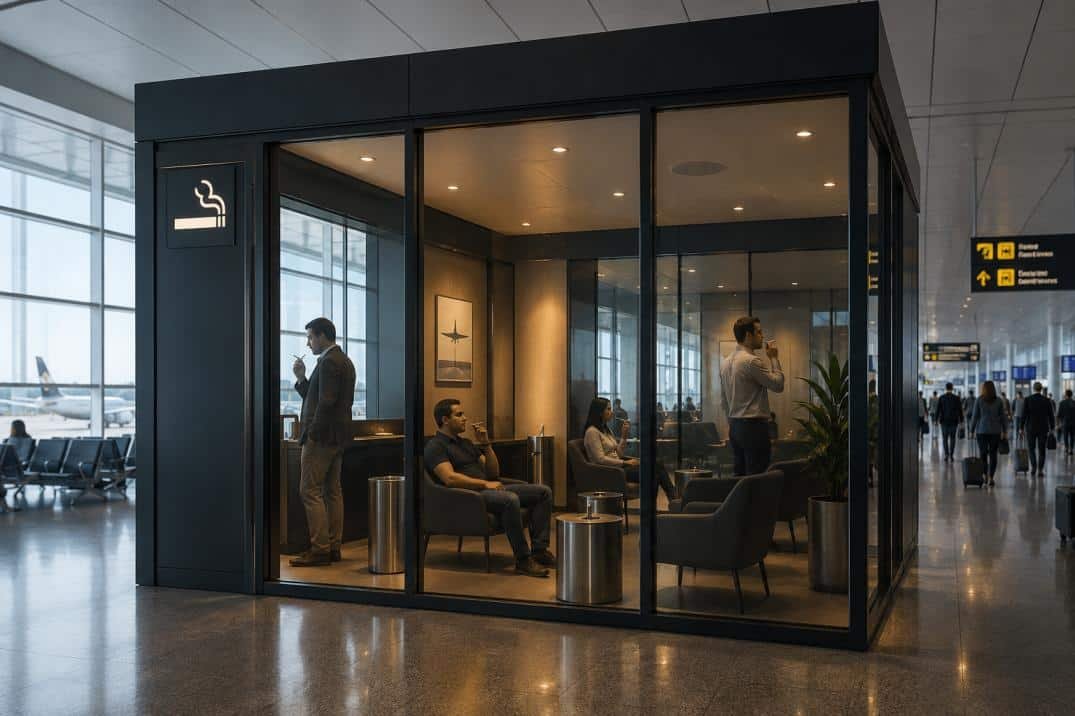
An airport smoking room is an enclosed, designated space inside or beside a terminal where passengers can smoke without leaving the secure area. SmokinMe designs and supplies airport smoking rooms, lounges and cabins for terminal operators. Each unit captures smoke at the source, filters it and recirculates cleaner air, with no external ducting.
Airports are one of the places Indian law explicitly allows a designated smoking area. That makes the question less about whether to provide one and more about whether the one you have works.
What a bad airport smoking room looks like at 7 p.m.
Three departures have just been called. The smoking room was sized for eight people and now holds twenty. The extraction fan can’t keep up. Someone props the door open with a bin because it’s stuffy, and a grey haze drifts across to the gate seating and the coffee counter. Passengers outside complain to staff. Staff complain to facilities. The cleaning crew spends twice as long in that room as anywhere else on the floor, and the walls still turn yellow by the end of the quarter. And the passengers who need it most can’t find it. Every month, hundreds of travellers search online for the smoking zone at Hyderabad, Bengaluru and Delhi airports. People search for something like that when signage has failed them. None of this is a passenger behaviour problem. It’s capacity, airflow and wayfinding.Do Indian airports have smoking zones?
Yes. Under the Prohibition of Smoking in Public Places Rules, 2008, the manager of an airport may provide a designated smoking area. That area must not be at the terminal’s entrance or exit, must be clearly marked as a smoking area in English and one Indian language, and may be used only for smoking, with no other service provided inside. Most large Indian airports provide one or more rooms airside.What airport operators need from a smoking room
Airports put more strain on a smoking space than any other site we work with. The design has to account for that.Peak capacity, not average use
Passenger flow at an airport comes in waves tied to the departure board. A room that’s half empty at 3 p.m. can be overloaded at 7 p.m. Size for the busiest 15 minutes after boarding calls, not the daily average.Containment that survives the door opening
The room usually sits close to gates, food outlets and retail. Every time the door opens, air moves. SmokinMe units capture smoke close to where people stand, which keeps less smoke in the room to escape when the door swings.Durability and fast cleaning
Hundreds of users a day means hard-wearing, fire-safe, wipeable surfaces. Fabric seating and porous walls absorb smoke and look worn within months.Clear wayfinding
If passengers can’t find the room, they’ll smoke in a washroom or a stairwell. Visible signage from the main concourse and a recognisable structure do more for compliance than any fine.No disruption to terminal operations
Construction airside means permits, security escorts and night work. Plug-and-play units avoid most of that.Airport smoking cabin vs built smoking room
Most older terminals have a built smoking room: a converted space with an exhaust duct to the outside. Newer projects often choose freestanding smoking cabins or lounge units instead.| Factor | Built smoking room | SmokinMe cabin or lounge |
|---|---|---|
| Installation | Civil work, ducting, airside permits | Placed and powered, no ducting |
| Smoke control | Depends on exhaust design and door discipline | Captured at source, filtered, recirculated |
| Relocation | Not possible | Can move when the terminal layout changes |
| Capacity changes | Rebuild needed | Add another unit |
| Downtime for installation | Weeks | Usually a day per unit |
Which is better for an airport?
For a new terminal with a fixed plan and the budget for external ventilation, a built room can work. For an existing terminal, a refurbishment, or a site that expects passenger numbers to change, freestanding cabins and lounge units are easier to install, expand and move. Many airports end up with both: a main lounge plus smaller cabins on remote concourses.How should an airport smoking lounge be designed?
Here’s the checklist we use on airport projects.- Count the peak. Use departure schedules to estimate the most people likely to use the space at once.
- Place it on the passenger path. Near gates and visible from the concourse, but not beside food outlets or seating.
- Keep the entrance away from main walkways. A self-closing door that opens away from foot traffic reduces drift.
- Capture at source. Filtration close to where people stand, not a single ceiling fan at one end.
- Choose materials for daily cleaning. Hard, fire-safe, wipeable finishes.
- Plan standing and seating. Most users stay five to seven minutes. Standing positions let more people use the space comfortably.
- Signpost it. Signage from the concourse, plus the mandatory smoking-area signage at the door.
- Agree maintenance before opening. Filter changes and cleaning on a schedule tied to footfall.
Domestic, international and remote concourses
Different parts of a terminal need different answers. Main airside lounge. The highest-traffic location, usually serving several gates. This is where a larger lounge configuration makes sense. Remote or bus-gate areas. Lower traffic but long waits. A compact cabin stops passengers improvising. International transfer zones. Transit passengers can’t leave the secure area at all, which makes a smoking room more important here than anywhere else. Landside forecourt. Outdoor smoking zones near drop-off and arrivals, away from the entrance doors. Our outdoor smoking shelters are built for this, including monsoon and summer heat.Keeping a high-traffic smoking room clean
The smoking room that works on opening day and the one that works a year later are often the same room. The difference is maintenance. Airport rooms see more use in a day than an office cabin sees in a month, so the schedule has to match. Filters load faster with heavy use. When they saturate, smell rises, users complain, and someone props the door open to “air it out.” That one habit undoes most of the containment. We set filter replacement intervals from actual footfall, not a generic calendar. Daily cleaning covers ash receptacles, surfaces and the floor; weekly checks cover door closers, seals and lighting. A door that no longer closes properly is the most common fault we find on airport visits, and the cheapest to fix. It also helps to give cleaning and terminal staff one contact number for faults. A small issue reported the same day stays small. Contact Us!Why airports choose SmokinMe
No ducting. Units filter and recirculate air, so there’s no external exhaust to route through a secure building. Fire-safe construction. Manufactured from fire-safe materials, which matters in a space full of lighters. Expandable. Need more capacity next year? Add another unit rather than rebuilding a room. Indoor, outdoor and lounge options from one supplier. One contract for airside rooms, remote-gate cabins and landside shelters, with one maintenance programme. See it working first. Your facilities team can visit our experience centre and test a running unit before committing. You can browse all units on our products page, or see how our indoor smoking units and smoking lounges compare.How an airport project works
- Site survey. Terminal layout, passenger flow data, available locations and airside constraints.
- Proposal. Unit types, number, sizes and positions, with a layout drawing.
- Quote. A written specification and price.
- Installation. Scheduled around terminal operations, typically during low-traffic hours.
- Maintenance. Filter replacement and servicing tied to actual usage.