Call Us At +91 9811618476

Designated Smoking Zones
Designated Smoking Zones
Smoke-Free Hospital Campuses Support | SmokinMe
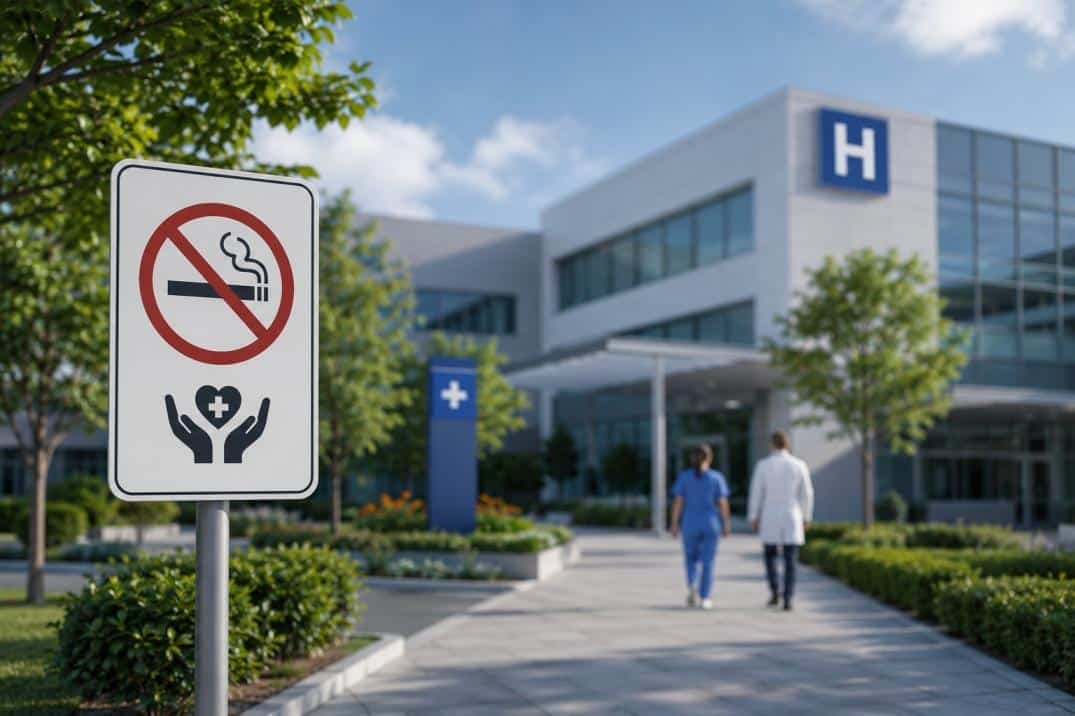
A smoke-free hospital is a healthcare facility where no one smokes anywhere on the premises, including buildings, corridors, parking and grounds. In India, smoking is prohibited in healthcare facilities, and hospitals are not among the places allowed a designated smoking area. SmokinMe works with healthcare facilities on the practical side of staying smoke-free: finding where people actually smoke, fixing why, and planning what happens at the boundary.
We’ll be direct about one thing. If you run a hospital in India, we won’t sell you a smoking cabin to put inside it.
The smoking problem every hospital already has
Walk around almost any large hospital in India at shift change. You’ll find it. A huddle of attendants by the side gate. A security guard behind the generator room. A patient’s relative on the ramp outside the emergency entrance, cigarette in one hand, phone in the other.
Every hospital has “No Smoking” boards. The boards aren’t the problem. People are anxious, they’re waiting for hours, and there’s nowhere obvious to go. So they go wherever is out of sight, and that’s often exactly where a patient on oxygen gets wheeled past.
Studies of hospitals in India have repeatedly found gaps between the law and what happens on the ground. Signs are missing or incomplete, butts collect by back doors, and enforcement depends on whoever is on duty.
A smoke-free campus policy only works if it’s designed around how people actually behave.
Is smoking allowed in hospitals in India?
No. COTPA prohibits smoking in public places, and healthcare facilities are among the places where smoking is fully banned. Unlike airports, large hotels and large restaurants, hospitals may not provide a designated smoking area. Some states go further and declare the whole hospital premises a tobacco-free zone.
Can a hospital have a smoking area for staff?
Not on the premises under the national rules. Staff are covered by the same prohibition as patients and visitors. Hospitals that want to support staff who smoke usually do it through cessation programmes and clear policies, not on-site smoking rooms.
How SmokinMe helps healthcare facilities
Our work in healthcare starts from the rules, not from a product.
1. Smoking hot-spot audit
We walk the campus with your facilities and infection-control teams and map where people actually smoke: side gates, service yards, parking, stairwells, the emergency ramp. Every hospital has three or four of these spots, and they’re rarely where management assumes.
2. Signage and wayfinding review
COTPA requires specific “No Smoking” signage in public places. We check what’s installed against what’s required and where people actually enter, and flag gaps. Signage at the right points, in the right languages, matters more than the number of boards.
3. Boundary planning
The hardest question is what happens at the edge of the campus. If people are told “not here,” they need to know where the premises end. We help you define and mark the boundary, so security staff can direct people clearly.
4. Litter and fire-risk points
Discarded cigarettes near oxygen stores, generator rooms or medical waste are a fire risk. We identify those points so your team can prioritise them for enforcement and cleanup.
5. Support for cessation messaging
The most effective hospital programmes pair enforcement with help to quit. Placing cessation information where smokers gather turns a confrontation into a referral.
Where SmokinMe products may fit
There are a few situations where a healthcare organisation may still use our products. Each depends on the local rules, and each should be checked first.
Healthcare organisations outside India. Some countries and emirates allow designated outdoor smoking shelters on hospital grounds away from entrances. If you operate there, our outdoor smoking shelters apply, subject to local regulation.
Separate non-clinical premises. A healthcare group’s corporate office or warehouse that is not a healthcare facility follows the rules for that type of premises, not hospital rules. Our products page covers those options.
Never inside an Indian hospital building or campus. We will tell you this upfront rather than after a site visit.
Why a cabin is not the answer for Indian hospitals
Facility managers sometimes ask whether an enclosed, filtered cabin changes the picture. It doesn’t. The prohibition is about where smoking may happen, not how well the smoke is filtered. A cabin on hospital premises would still be smoking on hospital premises.
Public health bodies also note that ventilation and separate rooms don’t fully remove exposure to secondhand smoke. In a building full of patients with heart and lung conditions, children and pregnant women, that matters more than anywhere else.
So the goal for an Indian hospital is a campus where nobody smokes, with clear boundaries, the right signage and support for people who want to quit.
What a smoke-free campus plan covers
| Area | What to check | Typical fix |
|---|---|---|
| Entrances and emergency ramp | Smoking by waiting relatives | Signage, security briefing, seating away from the door |
| Side and service gates | Staff and contractor smoking | Clear boundary marking, staff policy reminders |
| Parking and driver waiting areas | Drivers smoking in and near vehicles | Signage at driver bays, defined boundary |
| Stairwells and fire exits | Hidden smoking | Door alarms, patrols, signage at landings |
| Service yards, generator and oxygen areas | Fire risk from discarded cigarettes | Priority enforcement, regular checks |
A 30-day smoke-free campus reset
For hospitals that already have a policy but see it ignored, this is the sequence we suggest. It doesn’t need new construction.
Week 1: Map. Walk the campus at three different times: morning OPD rush, afternoon visiting hours, and night shift change. Mark every spot with butts, ash or smokers. Photograph each one. Most hospitals find the list is longer than expected, and that the worst spots are near entrances, ramps and service gates.
Week 2: Fix the signs and the boundary. Check signage against what the law requires at each entrance, and add it where people actually gather, not only at the main gate. Mark the campus boundary so security staff can say clearly where the premises end.
Week 3: Brief the people who enforce it. Security, ward attendants, housekeeping and department heads need the same simple message and the same response. Inconsistent enforcement is the main reason policies fail. Staff who smoke need to hear that the rule applies to them too, and where cessation help is available.
Week 4: Clear the hot-spots and re-check. Remove improvised ashtrays, clean the spots and repeat the walk from week 1 at the same times. Compare the photographs.
Then repeat the check every quarter. Hot-spots move; a quarterly walk catches new ones before they become habits.
Tobacco-free campus: more than smoking
Many Indian hospitals now adopt tobacco-free campus policies that also cover gutka, khaini and other smokeless tobacco. The approach is the same: find where it happens, explain the rule clearly, enforce it consistently and offer help to quit. Contact Us!
Frequently asked questions
Is smoking allowed anywhere on hospital premises in India?
No. Smoking is prohibited in healthcare facilities, and hospitals may not provide designated smoking areas. Some states declare the entire hospital premises tobacco-free.
Can a hospital install a smoking cabin with filtration?
Not in India. The rules restrict where smoking may happen, and filtration doesn’t change that. A cabin on hospital premises would still be smoking on hospital premises.
How do hospitals stop people smoking at the gate?
Combine clear signage at the right points, a defined campus boundary, consistent security response, and cessation messaging where smokers gather. Most hospitals see the biggest improvement once they map the actual hot-spots.
What is a tobacco-free hospital campus?
A campus where no form of tobacco, smoked or smokeless, is used anywhere on the premises, supported by signage, enforcement and access to cessation help.
Who is responsible for smoking on hospital premises?
Individuals who smoke can be fined, and the person in charge of a public place has duties under the law, including displaying the prescribed signage and not permitting smoking. Hospitals usually assign this to administration and security, with a named contact displayed at entrances for complaints.
What should security staff say to someone smoking at the gate?
Keep it short and consistent: the campus is smoke-free by law, here is where the premises end, and here is where to find help to quit. Staff who use the same words every time are taken more seriously, and conversations stay calmer.
Does SmokinMe work with hospitals outside India?
Yes, where local rules allow designated outdoor smoking areas on healthcare grounds. We confirm the local requirements before recommending anything.
Talk to us about a smoke-free campus
If your hospital is struggling with informal smoking spots, we can help you map them and plan a fix within the rules.
SmokinMe · Purulia House, B 404, Chittaranjan Park, New Delhi 110019 · +91 98116 18476 · info@smokinme.com