Call Us At +91 9811618476

Designated Smoking Zones
Designated Smoking Zones
What Is Third-Hand Smoke? The Hidden Risk Beyond Secondhand Smoke
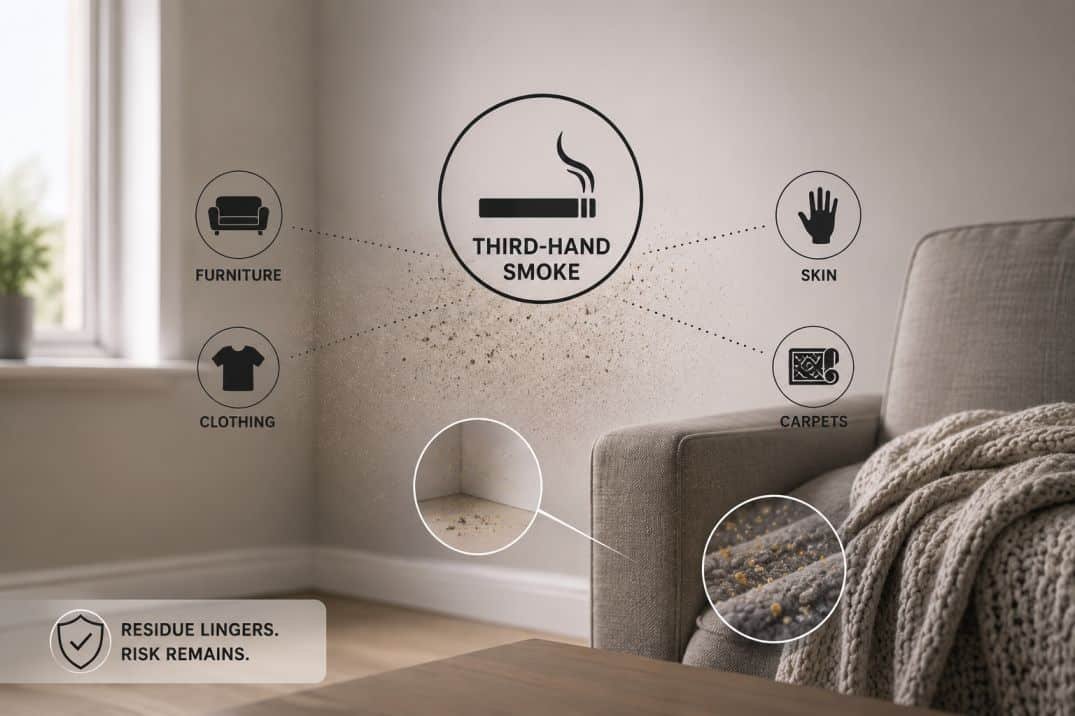
Most people understand secondhand smoke — the smoke a bystander inhales when someone lights a cigarette nearby. Far fewer have heard of third-hand smoke, even though it lingers in the very spaces we assume are already smoke-free. If you’ve ever walked into a room that smelled faintly of cigarettes hours after someone last smoked there, you’ve encountered third-hand smoke directly, whether you recognised the term or not.
At SmokinMe, understanding third-hand smoke isn’t just an academic exercise — it’s central to why we design smoking cabins with genuine multi-stage filtration rather than simple ventilation. This guide explains exactly what third-hand smoke is, how it differs from the secondhand exposure most people already know about, why it matters for workplaces and shared spaces, and what actually prevents it.
Defining Third-Hand Smoke
Third-hand smoke refers to the residual nicotine and other chemicals from tobacco smoke that remain on surfaces, in dust, and in fabrics long after a cigarette has been extinguished and the visible smoke has cleared. Unlike secondhand smoke, which is inhaled directly from the air while someone is actively smoking, third-hand smoke is a residue — it settles onto walls, furniture, carpets, clothing, and skin, where it can persist for weeks, months, or in some cases considerably longer.
This residue isn’t inert. Nicotine and other tobacco smoke compounds can react with common indoor air pollutants — including ozone and nitrous acid, both naturally present in typical indoor environments — to form new compounds, some of which are themselves carcinogenic. This means third-hand smoke isn’t simply “old smoke sitting around harmlessly” — it can actually become more chemically complex and potentially more hazardous over time as it interacts with its surroundings.
Third-Hand Smoke vs. Secondhand Smoke: The Key Difference
The distinction between these two forms of smoke exposure matters more than it might first appear:
Secondhand smoke is smoke exhaled by a smoker or released from the burning end of a cigarette, inhaled directly by someone nearby while smoking is actively occurring. Once the cigarette is extinguished and the air clears, secondhand smoke exposure from that specific event ends.
Third-hand smoke is what’s left behind after the visible smoke is gone. It doesn’t require an active smoker or a lit cigarette to be present — the residue clings to surfaces and continues off-gassing and exposing people in the space long after smoking has stopped. A room can be completely free of visible smoke and still carry meaningful third-hand smoke exposure.
This is precisely why “the smoke has cleared” isn’t the same as “the space is genuinely smoke-free.” A smoking area that looks clean and smells faintly of cigarettes — rather than nothing at all — is very likely carrying real third-hand smoke residue, even without anyone currently smoking in it.
Where Third-Hand Smoke Accumulates
Third-hand smoke residue settles wherever airborne smoke particles can land and adhere. Common accumulation points include:
- Soft furnishings — carpets, curtains, upholstered furniture, and cushions absorb and retain smoke residue particularly effectively due to their porous, fibrous surfaces.
- Walls and ceilings — painted surfaces, especially in poorly ventilated rooms, accumulate a visible yellow-brown residue over time in heavily used smoking spaces.
- Hard surfaces — tables, countertops, and electronics collect a thin film of residue that isn’t always visible to the eye but is measurable through surface testing.
- Dust — household and office dust absorbs and carries tobacco smoke compounds, spreading residue beyond the immediate smoking area as dust circulates.
- Clothing and skin — anyone who has spent time in a smoking environment carries some degree of residue on their clothing and hair, which can then transfer to other surfaces they contact afterward.
This is part of why a smoking room with poor filtration creates a compounding problem over time. Each smoking session adds a small amount of additional residue to surfaces throughout the space, and without proper filtration actively removing particles from the air before they settle, that residue accumulates session after session, day after day.
Why Third-Hand Smoke Matters for Workplaces and Shared Spaces
For any business managing a designated smoking area — an office, a hotel, a mall, an airport lounge — third-hand smoke has direct practical implications beyond the immediate air quality during active smoking:
Persistent odour complaints. A smoking room that smells strongly of cigarettes even when unoccupied is very likely accumulating third-hand smoke residue on its surfaces. This is one of the most common facilities complaints associated with poorly filtered or poorly maintained smoking areas, and it often continues even after ventilation improvements that address only airborne smoke during active use.
Exposure risk for cleaning and maintenance staff. Employees responsible for cleaning a smoking area are handling surfaces with accumulated residue directly and repeatedly, often without any specific protective protocol, since third-hand smoke isn’t as widely understood or planned for as direct smoke exposure.
Exposure for non-smokers using the same space at different times. If a smoking area is later repurposed, or if non-smokers pass through or briefly use the same physical space, they can be exposed to residue even without ever being present during actual smoking.
Long-term surface and material degradation. Beyond health considerations, accumulated residue affects the appearance and lifespan of furnishings, walls, and fixtures, adding to facilities maintenance costs over time in poorly filtered smoking spaces.
What Actually Prevents Third-Hand Smoke Accumulation
Understanding third-hand smoke changes how you should evaluate a smoking solution. A system that only addresses visible smoke and immediate odour during active smoking — without genuinely capturing particulate matter before it settles on surfaces — is doing an incomplete job, even if the room looks and smells acceptable in the moment.
Effective prevention centres on capturing smoke particles at the source, before they have a chance to settle onto surfaces in the first place. This is the core principle behind proper multi-stage filtration:
HEPA-grade particle filtration captures the fine particulate matter in tobacco smoke before it can circulate through the room and settle on walls, furniture, and fabric. The higher the HEPA grade — HEPA-14 captures 99.95% of particles as small as 0.3 microns — the more effectively this happens.
Activated carbon filtration addresses the gaseous compounds and odour molecules that HEPA filtration alone doesn’t capture, reducing the chemical load that would otherwise settle into surfaces and continue off-gassing afterward.
Source-capture design — positioning filtration to draw air in immediately at the point of exhale rather than relying on general room ventilation — meaningfully reduces how much smoke has the chance to disperse and settle on surfaces before being filtered.
We build every SmokinMe smoking cabin around exactly this combination, specifically because addressing only visible smoke and immediate odour, without capturing the underlying particulate matter, leaves the third-hand smoke problem largely unsolved.
Materials Matter Too
Beyond filtration, the materials used inside a smoking cabin affect how much residue accumulates over time. Non-porous, easy-to-clean surfaces resist residue buildup far better than porous or fabric-based materials, which is why we prioritise hard, wipeable surfaces throughout our cabin interiors rather than upholstered seating or soft furnishings that would otherwise absorb and retain smoke residue.
This is also why regular cleaning matters even with strong filtration in place — filtration reduces how much particulate matter is in the air to begin with, but some settling still occurs over time with any smoking space in regular use, and routine cleaning of hard surfaces prevents that residue from accumulating to problematic levels.
Third-Hand Smoke and Smoking Cabin Design
This understanding directly shapes how we approach smoking cabin design at SmokinMe. A cabin that merely clears visible smoke but doesn’t genuinely filter particulate matter at the source will still accumulate third-hand smoke residue over time, regardless of how effective it appears during a brief visual inspection. The difference between a cabin that looks compliant and one that’s genuinely solving the underlying air quality problem often comes down to exactly this — whether the filtration is capturing particles before they settle, not just moving air around the room.
We recommend anyone evaluating a smoking solution — whether from SmokinMe or another provider — ask specifically about particle filtration grade and source-capture design, not just general claims about “clean air” or “odour control.” A smoking cabin that smells fine when you visit during a demonstration isn’t necessarily one that’s preventing third-hand smoke accumulation over months of continuous, real-world use. Explore all products of SmokinMe
Why This Matters Beyond Health Considerations
While the health implications of third-hand smoke exposure are a genuine and ongoing area of research, the practical business case for addressing it is straightforward regardless: a smoking area that accumulates visible residue, generates persistent odour complaints, and degrades faster than it should represents an ongoing facilities cost and a recurring source of employee or guest dissatisfaction. Getting the filtration right from the outset — addressing third-hand smoke prevention as a core design requirement, not an afterthought — avoids this entire category of problem.
Why SmokinMe for Genuine Smoke and Residue Control
We design every smoking cabin around capturing smoke particles at the source, using combined HEPA-14 and activated carbon filtration, paired with hard, easy-to-clean interior surfaces that resist residue buildup. This isn’t just about how a cabin performs during active use — it’s about what happens to the space over weeks and months of continuous operation, which is where third-hand smoke accumulation becomes a genuine problem if filtration and materials aren’t addressing it properly from the start.
Contact SmokinMe today to discuss a smoking solution designed to genuinely control both visible smoke and the residue it leaves behind.
Frequently Asked Questions
What is third-hand smoke?
Third-hand smoke is the residual nicotine and other tobacco smoke chemicals that remain on surfaces, in dust, and in fabrics after visible smoke has cleared. It settles on walls, furniture, carpets, and clothing, where it can persist for weeks or months, unlike secondhand smoke, which is inhaled directly during active smoking.
How is third-hand smoke different from secondhand smoke?
Secondhand smoke is inhaled directly from the air while someone is actively smoking nearby. Third-hand smoke is the residue left behind afterward, settled onto surfaces, which continues to expose people in the space even after the visible smoke and active smoking have stopped.
Where does third-hand smoke residue accumulate the most?
Soft, porous surfaces like carpets, curtains, and upholstered furniture absorb and retain the most residue, along with walls, ceilings, hard surfaces, dust, and even clothing and skin of anyone who spends time in a smoking environment.
Can third-hand smoke residue become more hazardous over time?
Yes — nicotine and other tobacco smoke compounds can react with common indoor air pollutants like ozone and nitrous acid to form new compounds, some of which are carcinogenic. This means the residue doesn’t simply remain inert; it can become chemically altered over time.
Does a smoking room with no visible smoke or odour still have third-hand smoke exposure?
It’s possible — a space can look and smell largely clean while still carrying measurable residue on surfaces, particularly if the room hasn’t been properly filtered or cleaned. Persistent faint odour, especially when the room is unoccupied, is often a sign of accumulated third-hand smoke residue.
How does filtration prevent third-hand smoke accumulation?
Effective filtration captures smoke particles at the source, before they disperse through the room and settle on surfaces. Combined HEPA-grade particle filtration and activated carbon filtration, positioned for source capture rather than general ventilation, significantly reduces how much particulate matter is available to settle and accumulate as residue over time.
Why do smoking cabin materials matter for third-hand smoke control?
Non-porous, easy-to-clean surfaces resist residue buildup far better than fabric or upholstered materials, which absorb and retain smoke residue. Hard, wipeable interior surfaces combined with strong filtration reduce both how much residue accumulates and how easily it can be cleaned when it does.
Is third-hand smoke a concern for cleaning and maintenance staff?
Yes — staff responsible for cleaning a smoking area handle surfaces with accumulated residue directly and repeatedly, often without a specific protocol addressing this exposure, since third-hand smoke is less widely understood than direct smoke inhalation.
How can I tell if a smoking cabin is genuinely preventing third-hand smoke buildup?
Ask specifically about particle filtration grade (such as HEPA-14) and whether the system uses source-capture design rather than general room ventilation. A cabin that smells acceptable during a brief visit isn’t necessarily preventing residue accumulation over months of continuous real-world use — genuine prevention depends on filtration quality, not just an initial impression.
What should businesses look for when choosing a smoking solution to minimise third-hand smoke?
Look for combined HEPA-grade particle filtration and activated carbon odour filtration, source-capture design that draws air in immediately at the point of exhale, and hard, non-porous interior surfaces that resist residue buildup. Contact SmokinMe to discuss a smoking cabin designed around genuine particle and residue control.
Also Read:- Smoking Solutions for Modern Workplaces: Cabins, Lounges & Vending, Compared