Call Us At +91 9811618476

Designated Smoking Zones
Designated Smoking Zones
Coin-Operated Cigarette Dispensers: How They Work and Where They're Legal
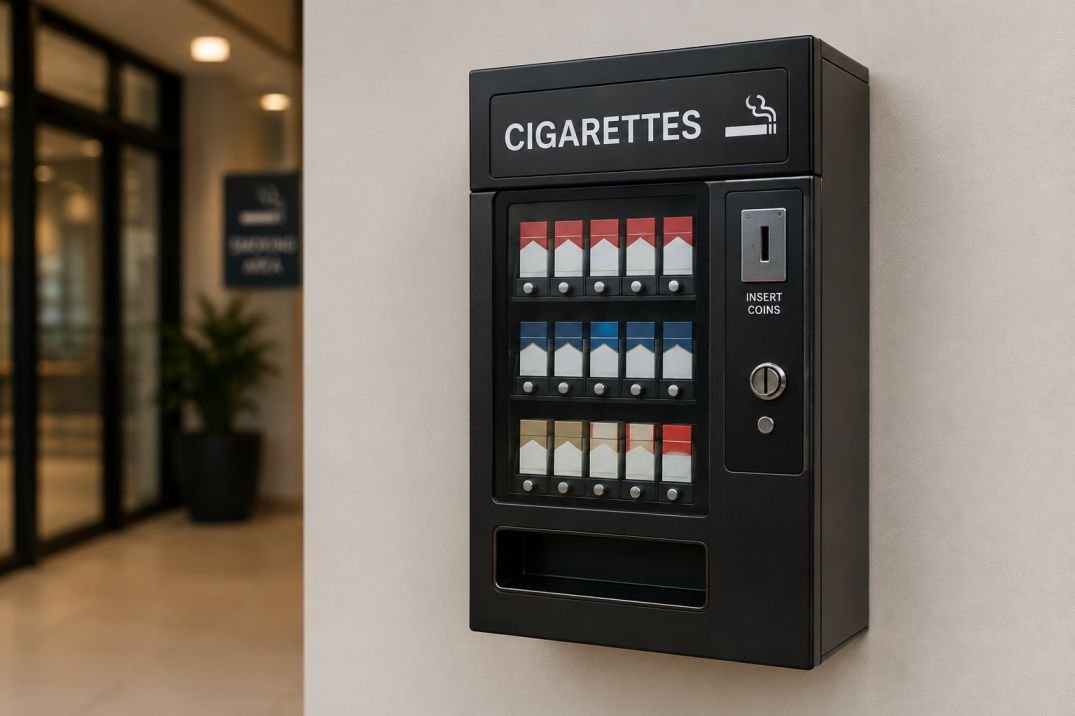
Coin-operated cigarette dispensers represent one specific format within the broader category of cigarette vending, distinguished by their simple, mechanical payment mechanism and minimal staffing requirements. Understanding how these units actually work — and the specific compliance questions their unstaffed, automated nature raises in India — helps businesses evaluate whether this format genuinely fits their property, or whether an alternative vending approach makes more practical sense.
This distinction matters more than it might initially seem. “Cigarette vending machine” is often used as a catch-all term covering several genuinely different formats — from fully staffed counters to sophisticated digital kiosks to the simplest coin-operated mechanical units this guide focuses on. Each format carries a different compliance profile, and treating them interchangeably when evaluating options for your property risks either overestimating the built-in safeguards a simple format actually provides, or overpaying for verification technology a lower-risk deployment context doesn’t strictly require.
This guide focuses specifically on the mechanics and legal context of coin-operated dispensers as a distinct format. For a broader look at cigarette vending compliance in India generally, see our companion guide on cigarette vending machines in India, which covers the full COTPA framework these dispensers also operate within.
How Coin-Operated Cigarette Dispensers Work
A coin-operated cigarette dispenser is a mechanical or semi-electronic vending unit that releases a product — typically a single pack or a specific quantity of cigarettes — once a customer inserts the required coin value. The mechanism itself is usually straightforward:
Coin acceptance and validation. The unit accepts coins through a slot, validating them against expected denominations before allowing a transaction to proceed. Some modern units also accept notes or digital payment as an addition to pure coin operation.
Product selection. Depending on the unit’s design, customers either select from a limited range of pre-loaded products via a simple mechanical lever or button, or the unit dispenses a single available product type automatically once payment is validated.
Dispensing mechanism. Once payment and selection are confirmed, an internal mechanical or motorised system releases the selected product into a collection tray or slot.
Restocking and maintenance. Unlike staffed retail, coin-operated units require periodic restocking by an operator, along with routine maintenance of the coin mechanism and dispensing system to prevent jams or malfunctions.
The core appeal of this format is its simplicity and low ongoing operational overhead compared to a staffed counter — no continuous staffing is required, and the mechanical simplicity generally means lower maintenance complexity than a fully digital, app-connected vending system.
The Core Legal Challenge: Age Verification
The defining characteristic of a coin-operated dispenser — its fully automated, unstaffed operation — is also precisely what creates the most significant compliance challenge in the Indian context. Under India’s Cigarette and Other Tobacco Products Act (COTPA), 2003, sale of tobacco products to individuals under 18 years of age is prohibited.
A basic coin-operated mechanism has no inherent way to verify a buyer’s age before completing a transaction. Anyone who inserts the correct coin value receives the product, regardless of age. This creates a direct tension between the format’s core operational simplicity and a legal requirement that specifically depends on some form of verification step existing in the transaction.
Because of this, a purely automated, unstaffed coin-operated cigarette dispenser faces genuine legal risk in India if deployed without any accompanying verification mechanism. This isn’t a minor technicality — it reflects the core public health rationale behind the age-restriction requirement in the first place.
It’s worth noting that this challenge isn’t unique to India, but the specific regulatory environment here — combining COTPA’s federal framework with potential state-level variations — makes the verification question particularly important to resolve properly before deployment, rather than treating it as a secondary consideration behind the format’s operational simplicity.
Where Coin-Operated Dispensers Can Legally Operate
Given the age-verification challenge, coin-operated cigarette dispensers in India are most defensibly deployed in contexts that address verification through means other than the dispenser itself:
Within staff-supervised areas. Positioning a coin-operated unit within a staffed or supervised space — where an attendant can intervene or verify age before a transaction, even if the dispenser itself doesn’t perform this function — addresses the core compliance gap.
Access-controlled adult environments. Properties where general public access is already restricted to verified adults — certain private clubs or similarly access-controlled venues — present a different risk profile, though the specific verification mechanism for the venue itself still matters.
Paired with supplementary verification technology. Some modern coin-operated or hybrid dispensers incorporate additional verification steps — such as requiring staff-issued tokens rather than accepting public currency directly — specifically to address the age-verification gap a purely public coin-accepting mechanism would otherwise have.
A fully public-facing coin-operated dispenser with no supplementary verification step, positioned in an unsupervised, publicly accessible location, represents the highest-risk deployment from a compliance standpoint and is generally not a configuration we’d recommend.
Coin-Operated Dispensers vs. Other Vending Formats
Compared to a staffed counter or a modern digital vending machine with integrated verification technology, a basic coin-operated dispenser offers the lowest operational complexity but also the weakest built-in compliance safeguard. This trade-off is worth weighing carefully against your property’s specific context:
- A staffed counter directly solves age verification through human oversight but carries ongoing staffing costs.
- A modern digital vending machine can sometimes incorporate verification technology (such as ID scanning) directly into the transaction flow, addressing the gap a basic coin mechanism doesn’t.
- A basic coin-operated dispenser offers the simplest, lowest-cost operation but requires an external verification solution — staff supervision or access control — to meet compliance requirements responsibly.
For most properties in India considering cigarette vending, we generally recommend evaluating whether the operational savings of a purely coin-operated format genuinely outweigh the compliance complexity it introduces, particularly when compared to a staffed or semi-staffed alternative that more directly addresses the core legal requirement.
A Note on Responsible Deployment
If your property is specifically considering a coin-operated cigarette dispenser, we strongly recommend treating age verification as a non-negotiable design requirement to solve before installation, not a gap to manage informally afterward. Options include staff supervision of the dispenser’s location, restricting access to the dispensing area to verified adults, or pairing the mechanical dispenser with a supplementary verification step.
We also recommend confirming current COTPA requirements and any applicable state-level regulations with a qualified legal or compliance advisor before finalising any cigarette dispensing installation, given the genuine regulatory sensitivity this specific format carries.
Where SmokinMe Fits
We offer vending solutions as part of our broader smoking zone product line, generally recommending staffed or semi-staffed formats for any cigarette-specific vending given the age-verification considerations outlined above. If you’re evaluating vending options — including whether a coin-operated format genuinely fits your property or whether an alternative approach better addresses compliance requirements — we’re happy to discuss your specific situation.
Contact SmokinMe to discuss vending options for your property, including how to approach cigarette access responsibly within a designated smoking zone.
Frequently Asked Questions
How does a coin-operated cigarette dispenser work mechanically?
A coin-operated dispenser accepts coins through a slot, validates them against expected denominations, allows product selection via a mechanical lever or button, and then releases the selected product through an internal dispensing mechanism once payment is confirmed. The unit requires periodic restocking and maintenance of the coin and dispensing mechanisms.
Are coin-operated cigarette dispensers legal in India?
Coin-operated dispensers face genuine compliance complexity in India specifically due to COTPA’s prohibition on tobacco sale to minors, since a basic coin mechanism has no inherent way to verify a buyer’s age. Legal, responsible deployment generally requires pairing the dispenser with staff supervision, access control, or supplementary verification technology, rather than operating as a fully unsupervised, publicly accessible unit.
What’s the main compliance risk with coin-operated cigarette dispensers?
The core risk is age verification — since anyone who inserts the correct coin value receives the product regardless of age, a purely automated dispenser with no verification mechanism creates direct exposure under COTPA’s minor-sale prohibition. This is the central compliance consideration for this specific vending format.
Where can coin-operated cigarette dispensers legally operate in India?
They’re most defensibly deployed within staff-supervised areas where an attendant can verify age before a transaction, in access-controlled adult environments, or paired with supplementary verification technology that addresses the gap a basic coin mechanism creates. A fully public, unsupervised deployment carries the highest compliance risk.
What’s the difference between a coin-operated dispenser and a digital cigarette vending machine?
A coin-operated dispenser typically uses a simple mechanical or semi-electronic mechanism accepting only coins, with no built-in verification capability. A digital vending machine can sometimes incorporate additional verification technology directly into the transaction flow, offering a more direct way to address age-verification requirements than a basic coin mechanism alone.
Do coin-operated cigarette dispensers require staff supervision in India?
Given the age-verification challenge inherent to a purely mechanical, unsupervised format, we generally recommend staff supervision or another verification mechanism as a practical necessity for responsible, compliant operation in India, even though the dispenser itself doesn’t technically require a staff member to complete a transaction.
How do coin-operated dispensers compare to staffed cigarette counters?
A coin-operated dispenser offers lower operational complexity and cost but a weaker built-in compliance safeguard for age verification. A staffed counter directly addresses verification through human oversight but carries ongoing staffing costs. The right choice depends on weighing your property’s operational priorities against its compliance risk tolerance.
What maintenance do coin-operated cigarette dispensers require?
These units need periodic restocking of product inventory and routine maintenance of the coin validation and dispensing mechanisms to prevent jams or malfunctions. Maintenance frequency depends on transaction volume, with higher-footfall locations requiring more frequent servicing.
Should my business install a coin-operated dispenser or a different cigarette vending format?
This depends on whether the operational simplicity of a coin-operated format genuinely outweighs its compliance complexity for your specific property. For most Indian businesses, we recommend evaluating a staffed or semi-staffed alternative first, given how directly it addresses the core age-verification requirement compared to a basic coin mechanism.
Where can I learn more about the broader legal framework for cigarette vending in India?
See our companion guide on cigarette vending machines in India, which covers the full COTPA regulatory framework applicable to any cigarette vending format, including coin-operated dispensers. Contact SmokinMe to discuss compliant vending options for your property.
Also Read:- Cigarette Vending Machines in India: Rules, Compliance & Where They’re Used